What are paperless technology abilities, risks and benefits?
Abilities include functionality to capture, receive, store, index, version, route, approve, manage, retain and dispose of electronic content. Electronic content include that are created internally, such as text, word processing, spreadsheet, engineering drawing and presentation, received from external sources, i.e., email, PDF, TIFF, voice and video, or scanned from paper.
Paperless technology modules include:
- Capture: the ability to receive documents through scanning (from paper) and upload from email, desktop applications (word, spreadsheet, etc.) and shared network drives.
- Recognition: translation of scanned document text or handwriting to full or selected text. Can also include recognition of barcode(s) placed on documents representing key index(s).
- Signature: authorization using simple annotation (finger, mouse, electronic pen), digital signature (validation of signature, type, speed and pressure) or pin code.
- ECM: storage, view, print and send of electronic content, indexes, attributes (version, author) and access security.
- Workflow: routing of a work packet for view, analysis or approval in a sequential or parallel manner.
- ERM: retention and disposition of content upon close date and retention period date. Some ERM allow for legal holds.
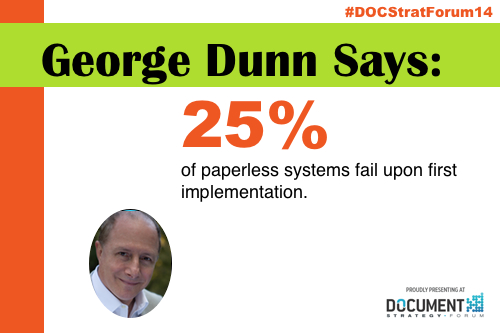
Risks regarding paperless technologies include the entire system not functioning as expected, issues with specific modules, rejection by staff, failure to meet ROI expectations or the organization becoming less efficient. In CRE8 Independent Consultant discussions with end users, we find that 25% of paperless systems fail upon first implementation, 45% perform in a mediocre fashion, and 30% fully meet all expectations (functionality, expandability, acceptance and return on investment).
When properly planned and implemented, dramatic increases in efficiency, decision making, tracking, tracing, measurements and knowledge documentation is possible. Labor cost decrease, quality increase and service improvement can range from 5% to 25%.
As planning for process improvement and advanced paperless technologies must be tailored to the specific need of each organization, the information provided here should be treated as an introduction only and, as such, without a direct consultation of requirements, I cannot assume responsibility for the use, implementation or results information provided.
Mr. Dunn will be presenting on Tuesday, May 13, 2014 at the DOCUMENT Strategy Forum. Don't miss his Power Session P204/P205 “Taking Automation a Step Further: Process Innovation & Advanced Paperless Technology.” For more information, visit www.DOCUMENTstrategyForum.com.